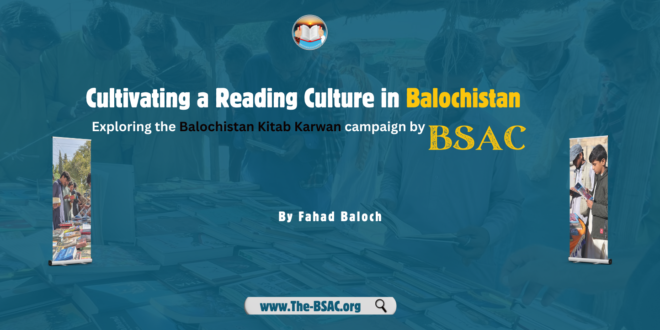
Cultivating a Reading Culture in Balochistan: Exploring the Balochistan Kitab Karwan campaign by BSAC
By: Fahad Baloch
The transition from the Dark Ages to the modern era of enlightenment is not merely a fortuitous change or a natural process, but rather a deliberate advancement, as evident throughout literature. In the history of Islam, it is claimed that the faith transformed the world from an era of ignorance to one of enlightenment with the revelation of the Holy Quran, bestowed upon humanity by Allah Almighty. This marked the beginning of an era of illumination and consciousness. We can infer that knowledge is, in fact, the true path to consciousness, with literature serving as its primary source.
We continue to study the works of ancient Greeks, including the venerable Plato, Aristotle, and Socrates, whose literature remains relevant in our modern knowledge system. Their writings, penned in the early centuries Before Christ (BC), remain remarkably valid today, not because contemporary literature is lacking, but because their works are timeless masterpieces that will undoubtedly inspire and guide humanity until a new paradigm shift occurs.
In addition, We are well-versed in the literary works of Marxism, Engels and Veladimir Lenin, as well as European and Western literature. It is not merely a matter of familiarity, but rather a de facto form of communication through literature. Moreover, in the modern world, we witness national movements that have successfully achieved their political ends through the mere power of literature. These movements have identified and addressed their errors through writings and contents in shape of literature, exemplified by the Cuban Revolution’s Che Guevara, Fidel Castro, and Regis Debray.
Similarly, the Palestinian national movement has been influenced by the writings of Ghassan Kanafani and Mahmoud Darwish. Abdullah Ocalan’s political writings have also played a significant role in Kurdistan’s National Liberation Movement, challenging existing literature with his innovative ideas. Amilcar Cabral’s speeches, later transcribed into written form, were instrumental in Guinea-Bissau’s national movement. Chairman Mao Tse-Tung, the leader of the Chinese Liberation Movement, extensively wrote on various subjects, addressing defects and challenges within the movement through his writings in form of literature.
Notwithstanding, The Baloch national struggle, continue against colonialism, also necessitates literature as a fundamental prerequisite. Through literature, we can comprehend the historical context of our struggle, introduce new ideas, and offer diverse perspectives. To strengthen Baloch nationalism, it is essential to produce more literature, ensuring accuracy in theoretical contexts and justifying our stance through literary evidence. The Baloch must study their leadership, past and present, to understand their future, their enemy, and to identify and diagnose defects and flaws within the ongoing struggle.
Coming to the point, To achieve this, cultivating a reading culture is crucial, and it must be developed as a habitual practice.
Although, there was a lacuna of grassroots politics from 2014 to 2018, even the smallest initiative seemed like a beacon of hope for the Baloch, particularly students. The preceding years had been incredibly challenging, making it difficult to envision any scope for political engagement, including modest study circles. Consequently, an entire generation had drifted away from a book-reading culture, unaware that political activism and a regular reading habit are essential for societal progress.
Furthermore, During this period, the leadership of student organization, Baloch Students Action Committee, may be called as a group of some visionary individuals, cognizant of the dearth of grassroots politics among the Baloch, courageously stepped forward, willing to face potential consequences. They initiated a series of political activities aimed at reviving a book-reading culture. The leadership of the Baloch Students Action Committee (BSAC) conceived a plan to spread this movement across Balochistan by organizing book stalls in various areas, naming the program “Balochistan Kitab Karwan.”
Initially, it seemed unlikely that such programs would exert significant political influence or revive grassroots activism, and would instead be fleeting. Contrary to these expectations, the initiative has evolved into a potent catalyst for political engagement in Balochistan, undergoing a transformative journey toward greater effectiveness with each passing day.
Although initially limited to specific areas with scarce political literature for Baloch youth, the Baloch Student Action Committee (BSAC) has now expanded the scope of Balochistan kitaab Kareaan and broadened its literary horizons to cater to the evolving needs of the Baloch nation.
Nonetheless, I firmly believe that the present-day book-reading culture among Baloch people, particularly students, has been significantly influenced by this initiative. Through organized stalls, BSAC has instilled a habit of reading culture, encouraging individuals to purchase books and cultivate a deeper understanding of the world, themselves and their ongoing movement cum National struggle.
Indubitably, It is essential to acknowledge that developing a book-reading habit is a crucial factor in enhancing our cognitive abilities, vigilance, knowledge, and adaptability to the rapidly changing world.
As, In today’s colonial era, where embracing new ideas, technological advancements, and innovative literature from diverse nations and societies is vital, reading widely and engaging in broader political activities has become imperative, and we as the colonized nation have to adapt such significant changes and ideas.
Furthermore, In response to the demands of modern society and the complexities of the contemporary world, the leadership of BSAC has decided to further expand the Kitab Karwan’s scope, making it more inclusive and comprehensive across all aspects of Balochistan. The upcoming literature will encompass a wide range of texts, including rare and outstanding works that cater to the demands of today’s world. According to the leadership, this initiative will provide access to highly effective and essential literature, enabling individuals to navigate the complexities of the technological age.
Through its media channels, BSAC has announced a series of book-stalls across Balochistan, commencing on January 1st, 2025, to welcome the new year. The organization has extended an invitation to people from all walks of life, particularly students, to actively participate in the upcoming events, which will be held in various locations across Balochistan.
In conclusion, the Balochistan Kitab Karwan initiative has been a significant step towards promoting knowledge, literacy, and political engagement among the Baloch people. Despite the challenges, the initiative has achieved significant progress in it going forward with a salience manner to attract the Baloch readers and to all those who haven’t yet read their nation, its history, culture and movement.
This, I believe with a hope will bring a creative world for us to know ourselves and to detect the defects in our ongoing national struggle through the help of reading these literature which seems to be rare.