Central Spokesperson of Baloch Students Action Committee
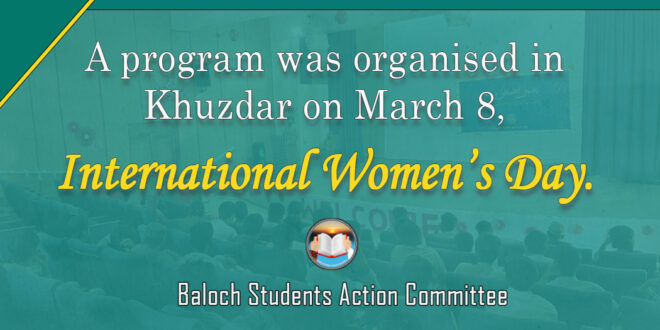
On International Women’s Day, March 8, a program was organised in Khuzdar, at which Chairman Uzair Baloch participated as the chief guest. The program comprised of various segments including Speech, Panel discussion, documentary, drama, pamphlet and research paper reading.
The program commenced with the Baloch Raaji Soth and followed by the reading of pamphlet and research paper. Then the documentary was presented before the audience which was prepared on account of International Women’s Day and it was followed by a panel discussion. The panel discussion was moderated by Waseem Baloch while Safia Baloch and Uzaifa Baloch participated as the panelists. They discussed about the International Women’s Day and the ongoing struggle of Baloch women for the rights. As they discussed that the women had taken to the streets and roads to protest and resist the oppressions and to protect their political rights in the given society as a political struggle in the early years of 1908 and 1912. It was because their effort the movement continued till the mid of World War I in 1917, where women protested against the poverty, hunger and peace under the Tsar regime. In endorsing their struggle and acknowledging their protests, the Bolshevik Party named the 8 March as Women’s Day and celebrated the day in 1922, then after years in 1955 the United Nations, in recognising the very existence of women as an equal and integral part of the society, named this day as International Women’s Day. In the same way the Baloch women became successful in participating all aspects of the society, in protecting their political and social rights, in the twenty first century. This is because of this political struggle, which women have endorsed, and are struggling with their courage and determination in this society. Continuing the program the next segment, a drama, was presented which highlighted stories of education and teaching to the women.
The drama was then followed by the speech of central chairman Uzair Baloch. He expressed his views and noted that International Women’s Day is observed globally to highlight women’s social and political rights. He further expressed that while women face modern suppression, this was not the case in pre-historic times. During the early human societies (i.e. hunter-gatherer era) labor was divided, men hunted for food while women managed agriculture and other social services. Over the time, factors such as imperialism, mercantilism and specific religious interpretations led to the erosion of the very rights of women.
The chairman further argued that while oppression exists globally, Baloch society historically maintains a highly respectable system for women. He stated that traditional Baloch customs grant women substantial privileges and autonomy. Historically, Baloch women have served as regional heads and leaders of resistance forces. However, he stated that the British colonialism and other foreign interventions altered the structure of Baloch society to facilitate foreign rule.
Today, Baloch woman are victims of political and government-based violence rather than domestic or individual violence. Despite these restrictions, Baloch women have not retreated. They struggle alongside men in the political arena. Resultantly, in Baloch politics, women are viewed primarily as political activists and human rights advocates. The Chairman concluded by arguing that the strength of Baloch customs is evidenced by the people’s willingness to unite under female leadership.
The final part of the program was featured by the concluding speech by the zonal president Sangat Munarak Baloch, who thanked every participant of the program and also praised the courage and determination of the Baloch women in the political activism