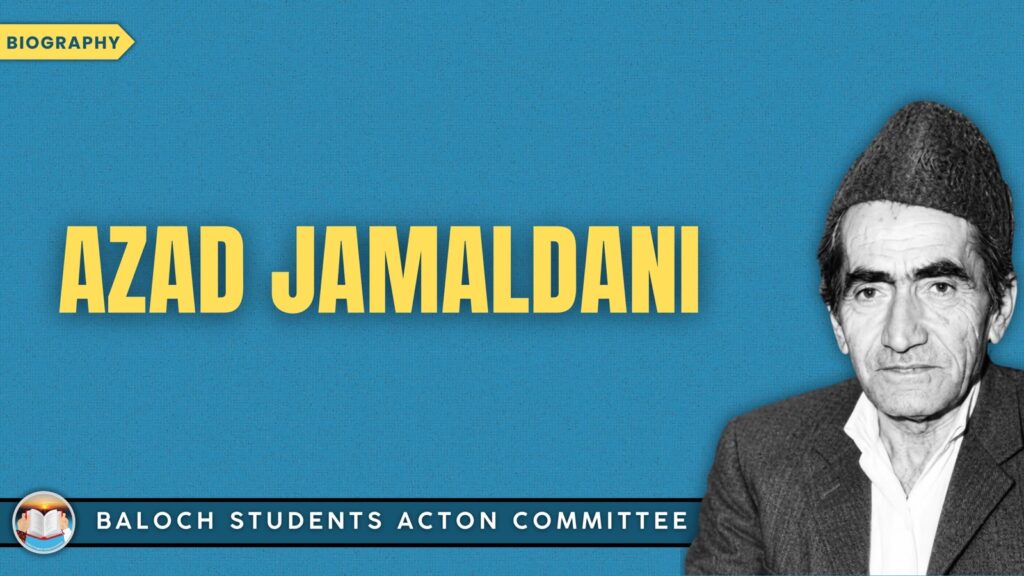
Biography of Abdul Wahid (Azaat) Jamaldini
Baloch Students Action Committee
Every nation has its legacies of ideas and struggles, which have been proven by the figures of that nation who have redefined the lives of the nation collectively. While one may often remember their contributions, the severe challenges they faced, and the sacrifices and hurdles they endured are frequently overshadowed during debates. Azaat Jamaldini remains one such figure; widely recognized for his exemplary contribution to Balochi and Brahui languages and literature, his struggle and journey of dedication led him to trials that might break the resolve of many, but Azad Jamaldini stood without wavering. Mir Abdul Wahid Azaat Jamaldini, respectfully known as ‘’Mama,’’ is a name of commitment, dedication, and inspiration in Baloch society throughout his lifelong devotion to Balochi and Brahui languages and literature. His efforts to formalize, preserve, and promote Balochi language and literature stand as a milestone for modern progress, while his verses and ideas were an inspiration for the upcoming generation. Throughout his struggling journey, Mama endured suppressions and severe hardships, yet his purpose rose above the very trials that caused others to step down.
Mir Abdul Wahid Jan (Azaat) Jamaldini was born in Nushki, Balochistan, into the house of Mir Khan Jamaldini. During the colonial period of Balochistan in the 20th century, Nushki was a vital hub of geopolitical and economic trade for the British Empire because of its strategic location and administrative outpost. The period of British occupation and economic barriers exposed the young Wahid to harsh realities in his early life. His early education began in a traditional mosque, and he later enrolled in a middle school, which was the only educational institution in the region. His pursuit of higher education brought him to the city of Quetta, where he gained admission to Sandeman High School. During his studies, Jamaldini was a young man with creative passion and curiosity, which led him, at one point, to abandon his studies and travel to Karachi with the intention of heading to Mumbai out of a passion for cinema; however, his ambitions failed when met with realities, and he continued his studies. Not much time had passed before a catastrophic earthquake hit Quetta, destroying almost everything. Fortunately for Jamaldini, his uncle had taken him and his little brother, Abdullah Jan Jamaldini, to Noshki before the heart-wrenching event.
After a prolonged period of unemployment, Jamaldini secured a job as a teacher in his area’s school, and his teachings contributed to the education of the youth. Throughout his academic and professional career, he was driven by a passion for his mother tongue and Balochi literature. He became significantly involved in Balochi when an English political agent named Captain Kohl arrived in Chagai and wanted to learn Balochi; therefore, Azaat Jamaldini took on the responsibility of instructing him in the Balochi language, which compelled him to explore Balochi language and literature through deep study. During his time teaching the Englishman, he was allocated a job in Peshawar. However, Jamaldini, with his free-spirited nature, was not satisfied with the environment and relocated to Nokundi, where he built his business and house for settlement. When his father passed away in 1939, Mama was faced with domestic responsibilities and took on the duties as the eldest son.
Azaat Jamaldini’s dream for the development of Balochi could not be contained, and after enduring hardships, he published his first book of poetry, entitled Mastein Tawaar, in 1953. The book portrayed the political suppression and violations committed against the Baloch nation and rallied people to unify against power through his verses. From then on, he faced scrutiny from the authorities, but despite the consequences, the fire within Mama was not extinguished. Jamaldini conceived the idea of a magazine that would be significant for the Balochi language and promote Balochi literature. This idea was transformed into reality with the publication of the magazine in 1954, titled Balochi Mahtaak. The magazine was a vital literary element that inspired generations with its work concerning socio-political and literary contributions. But as history repeats itself, the literary works of Azaat Jamaldini were viewed as threatening by the authorities; therefore, the magazine was declared banned, and Mama was imprisoned for 6 months. After his release from imprisonment, constant state repression forced him to abandon his literary activities, and financial constraints compelled him to work at Radio Pakistan in Quetta. However, Jamaldini’s nationalistic ideas would not let him be confined to a life of silence. Unwilling to remain constrained, he decided to travel to Zahedan and work at Radio Zahedan. In Zahedan, Mama engaged in political affairs and raised his voice against the political suppression of the Baloch nation in Iran, leading to constant threats from state authorities. Azad Jamaldini, unwavering in his ideology, decided to continue his work for Balochi and traveled to Dubai. But misfortune did not leave his side, and he was robbed upon his arrival in Dubai.
After this unfortunate incident, Azaat Jamaldini traveled back to his hometown and resumed publishing the Balochi magazine after his petition for republication was approved by the authorities. From then on, he traveled across Balochistan to collect funds for the further publication of his periodical as its reach expanded from Balochistan to the Gulf countries, inspiring and modernizing Balochi literature. Even in his final days, Azaat Abdul Wahid Jamaldini remained committed to his contributions to the Balochi language despite being acutely ill and later hospitalized. Azaat Jamaldini entered eternal rest on the 5th of September 1981, immortalizing his service to the Balochi language and leaving behind a legacy that continues to inspire generations.